

PHWIN Poker requires players to combine hand analysis, observation, and careful decision-making at the table. Every action can affect the remaining chip stack and the direction of a hand. When playing at PHWIN, understanding the rules, evaluating hand strength, and maintaining emotional control can help players develop a more structured approach to the game.
Overview of PHWIN Poker
Poker is a card game that combines probability, strategy, and situational awareness. Depending on the variant, players receive private cards, use community cards, or combine both to form the strongest five-card hand according to the rules.

One notable aspect of PHWIN Poker is the need to make decisions throughout multiple betting rounds. Players must consider not only their current hand but also their chip stack, table position, and the actions taken by other participants.
Even a strong hand does not guarantee victory because the outcome also depends on subsequent cards and how opponents respond. Therefore, understanding the rules is the first step before exploring more advanced strategies.
A Detailed Guide to Playing PHWIN Poker
To participate correctly, players need to understand the deck structure, hand rankings, and sequence of a poker hand. These fundamentals help them evaluate their current holdings and understand the available actions at the betting table.

The Deck and Poker Hand Rankings
In the popular Texas Hold’em variant, poker uses a standard 52-card deck without Jokers. Each player receives two private cards and can combine them with five community cards to form the best possible five-card hand under the rules.
- Royal Flush:The highest possible poker hand, consisting of A, K, Q, J, and 10, with all five cards belonging to the same suit.
- Straight Flush:A sequence of five cards in numerical order, all sharing an identical suit.
- Four of a Kind:A combination featuring four cards with matching ranks, accompanied by one additional card.
- Full House:A five-card hand made up of three cards of one rank and two cards of another matching rank.
- Flush:Any five cards from the same suit, provided they do not form a consecutive sequence.
- Straight:Five cards arranged in consecutive numerical order, with their suits not required to match.
- Three of a Kind:Three cards carrying the same rank, together with two other cards that do not form a pair.
- Two Pair:A hand containing two separate pairs, each pair consisting of cards with the same rank, plus one remaining card.
- One Pair:Two cards of equal rank combined with three unrelated cards.
- High Card:When a hand does not qualify for any recognized combination, its value is determined by the highest-ranking card.
Betting Rounds in a PHWIN Poker Hand
In Texas Hold’em, each hand begins with players receiving two private cards. The two players to the left of the dealer post the small blind and big blind, creating an initial pot before the first betting round begins.
- Pre-flop:Players evaluate their private cards and decide whether to call, raise, or fold.
- Flop:The first three community cards are revealed, allowing players to assess possible combinations.
- Turn:The fourth community card appears, potentially changing the strength and prospects of each hand.
- River:The fifth community card is revealed, completing the community board.
- Showdown:If at least two players remain after the final betting round, their hands are compared to determine the winner.
Basic Actions at the Betting Table
Each betting round offers different options depending on previous actions and the table rules. Understanding these actions helps players avoid mistakes and make more informed decisions.
- Check:Pass the action without adding chips when no bet needs to be called.
- Bet:Make the first wager in a betting round.
- Call:Match the current bet.
- Raise:Increase the current bet within the table’s limits.
- Fold:Give up the hand and forfeit the chance to win the current pot.
- All-in:Commit all remaining chips to the pot.
Effective Strategies for Playing PHWIN Poker
Beyond memorizing the rules, situational analysis also influences decisions at the table. Players should develop an approach based on starting-hand strength, opponents’ actions, and the amount required to continue, helping them avoid poorly considered choices.
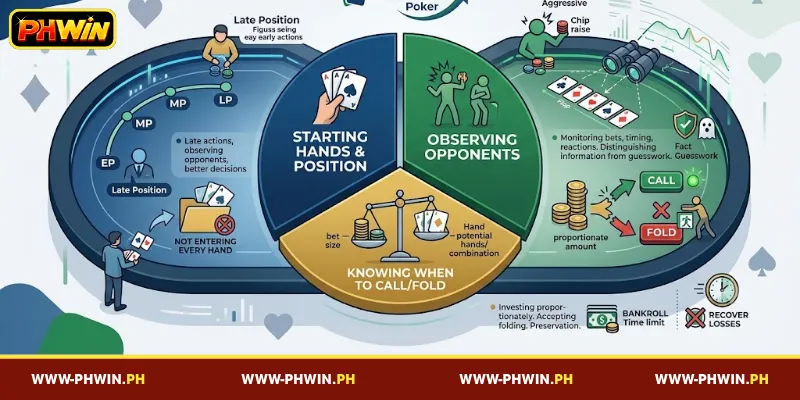
Adjust Your Starting Hands to Your Position
Starting-hand strength significantly influences decisions during the pre-flop round. High pairs and well-connected cards often have better potential, while disconnected, low-value cards can leave players in a difficult position.
Table position also affects how starting hands should be evaluated. Players acting later can observe the decisions made by those who act before them, while players in early positions must make decisions with less information about their opponents.
In PHWIN Poker, players should not enter every hand simply because they have been dealt cards. Consider starting-hand quality, table position, and the cost of entering the pot. Folding early when the situation is unfavorable can preserve chips for more suitable opportunities.
Observe Opponents and Evaluate the Situation
Opponents’ actions provide useful information for analysis, although they do not reveal their exact holdings. A player who frequently raises may have an aggressive style, but they could also hold a strong hand or use their position to apply pressure.
Players should monitor betting frequency, the timing of raises, and opponents’ reactions when community cards change. Rather than drawing conclusions from a single action, consider multiple signs within the same context to reduce the risk of misreading the situation.
When playing PHWIN Poker, distinguish observable information from personal assumptions. A sound decision should be based on the hand’s available evidence, the bet size, and the possible combinations on the board instead of relying on guesswork.
Know When to Call or Fold
Calling may be appropriate when there is a reasonable basis for continuing and the amount required is proportionate to the hand’s potential. However, investing chips in an earlier round does not mean a player must continue when new cards make the situation unfavorable.
Folding is necessary when the hand is unconvincing, the bet is too expensive, or the chances of improving the hand are limited. Knowing when to stop can reduce avoidable losses and preserve the remaining bankroll for future decisions.
With PHWIN Poker, set a spending limit before playing and avoid trying to recover previous losses through poorly considered bets. No strategy guarantees victory in every hand. The key is to evaluate each situation independently, accept folding when necessary, and maintain responsible playing habits.
Conclusion
PHWIN Poker requires players to understand hand rankings, follow betting rounds, and evaluate situations before taking action. By selecting suitable starting hands, observing opponents, and knowing when to stop, players can reduce poorly informed decisions. Learn the table rules at PHWIN, establish a clear budget, and treat poker as a form of entertainment with defined limits.
